You were created on purpose and for a purpose. Yet it’s easy to settle for a life centered on ourselves instead of the calling God placed within us. Rediscover the joy, meaning, and fulfillment that come when we step beyond ourselves and live the life we were truly made for.
So as I remind you, every single year at this time, this is the year where we're all a little bit focused on. It should be focused on self-improvement, where we're confronted with where we are and where we aren't and where we plan to be. By this time, this year as we started a new year, because last year we set some goals and set some resolutions and we were committed for about three days or three weeks or three months. But anyway, so here we are thinking about some of those same old things and that's good. This is the time of year where we're confronted with where we are and where we aren't with our goals, what we need to start and stop, what we need to do more of and less of what we need to eat more of and eat less of. It's the season where we ask, and again, this is a good thing.
I'm not complaining. This is the season where we ask what should I do about me and how can I make myself better? How can I make myself stronger? How can I make myself healthier? How can I make my relationships better? How can I make myself smarter, wealthier? How do I make myself more successful? Or how do I make myself less lonely? How do I make my relationships richer? And you should address all of those things, whatever those might be. You should get that degree. You should break that habit. You should get out of debt, you should get out of that relationship. You should go ahead and buy a ring and propose and quit messing around. So this is the year to do all of those things. Less work, maybe more family or maybe more work and a little less Netflix. Okay? You got to figure that out.
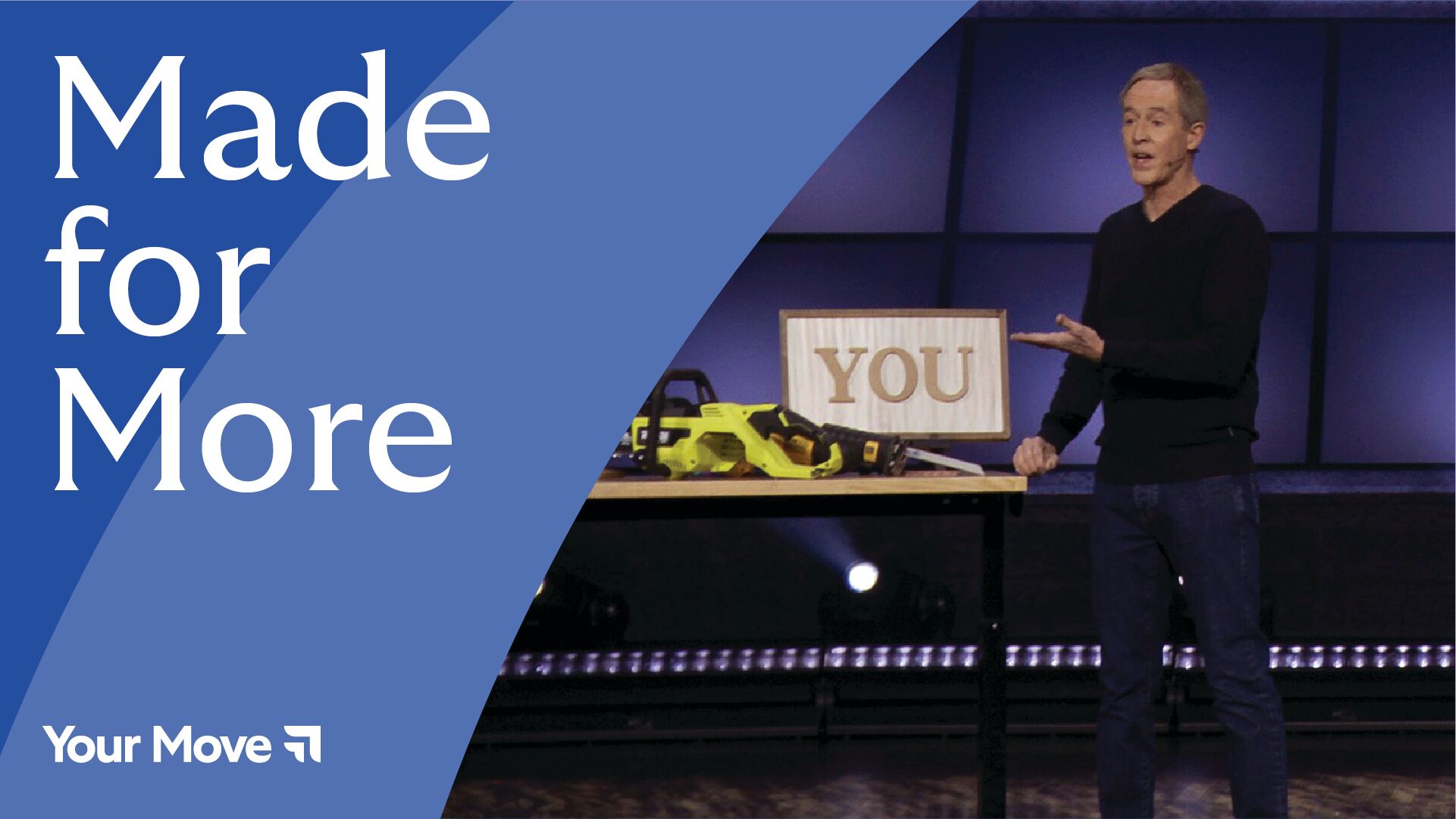
In addition to the question, what should I do about me or what should you do about you? Here's something to consider for the next few minutes, maybe for the next few weeks. And maybe you're going to want to write this question down and put it on your mirror because it may take a while for you to figure this one out. And it's so important. And the question is, what was I made for? What was I made for? Now to get us started, everybody knows what all of these things were made for. These were made not to take on a commercial flight. Did you know that? Have you seen the display at Hartsfield? They move it around from time to time, but all the things people have tried to take on commercial flights, weed eaters, literally chainsaws, all kind of just leaf blowers. Why would you take a leaf blower? Anyway, so these are things not to be taken on a commercial flight, but specifically the reason they're up here. All of these things were designed or created with a specific task in mind. They solve a problem, they address a need, they help something get done better and quicker than otherwise it would be done. So they were all created for something very, very specific. But I really want you to think about this for the next few minutes. What about you?
What were you made for? And here's the thing, it's hard to get there personally, but it's not so crazy when you think about other people because some people who have discovered what they are made for, people who know and you've seen them in their zone and when they're in their zone doing what they're made for, you have thought or you might have even said, wow, that's exactly what they were made for. They are doing their thing. That's what they were created to do. But here's the thing. When you find that thing, and it may be more than one thing and some of you know what it is, and some of you don't, some of you, you got to figure this out. When you're doing that thing that you were made for, you experience this deep, deep sense of satisfaction. There's energy, there's a sense of purpose.
You're not tired at the end, other people would be tired or they're shocked or they're amazed. And it like it gives you energy, it gives you life. And here's one of the reasons I'm talking about it. The more of that that you do, whatever that is, the more of that that you do, whatever that is, you should look for opportunities to do even more because it is critical to your wellbeing because of the way you were designed. It's critical to your happiness. In fact, you probably know that it may be critical to your health. It may be critical to your mental health that you figure out what you were made for and make sure you're giving enough of your time and your energy to that because it gives you energy and it allows you to experience time in a way that you don't experience any other way.
And when you don't give attention to it or you don't give enough attention to it, you pay for that. And I pay for that because of the way we were created, the way we were designed. We're discontent, we're frustrated. Sometimes there's a residual kind of anger that just sits there. We are no fun to be around. And then you know what we do? We start looking for a culprit. It's my boss, it's my job, it's my career. It's where we live. It's the weather. It's my spouse. It's my lack of a spouse, it's my fiance. It's the world. There's something we got to find somebody to blame for the fact that there's a deep sense of discontent because we're not doing enough of what we were designed and created to do. So one more time. What were we made for and do you know, have a suspicion of what it is.
So tease it out a little bit more. I'm going to give you a clue. What you were made for is something you actually do. It's something that doesn't end with you and it doesn't exclusively benefit you otherwise. You're like the dead sea. It's just all pouring in and nothing's going out. That's not what it's, it's something you do. It's something that doesn't exclusively benefit. You. Author Daniel Pink in his book that he wrote many years ago, drive, our leadership team, went through it years ago. He summarizes it this way. Maybe this will help give you some handles as you think about this. He breaks it down into three words. He says it's a combination of three things. One is autonomy, which is the desire for us to control or impact or really just direct our own lives. We all want some sense of autonomy. It includes mastery where there's an urge to make progress or get better at something specific and something that matters.
So there's mastery. You're kind of owning this and getting better at this. And then on the other side, which is similar to mastery is purpose. There's a yearning to do. There's a yearning to do what we do in the service of something larger than ourselves. Again, there's an outflow. It's not just for the benefit of you. So when you can find that something where all three of these come together, there's a sense of autonomy, you get to control it, a sense of mastery, you're getting better and better at it, and a sense of purpose, there's an outflow. It benefits somebody other than you. This is gold, this is health, this is peace. There's a sense of happiness there when you can figure out how to merge these three. And some of you have found a way to do this in your work. You spend most of your waking hours in an arena or in an environment where you're doing these things and good for you.
That's kind of rare. But for some of you, it may be a hobby, it may be a pastime, it may be substituting somewhere, it may be coaching, it may be mentoring. It may be something that you volunteer doing or something you do for your community. But whatever it is, it is energizing and it is life giving. So lemme say this, if you're not a religious person, you're not a Christian person, you put that in the rear view mirror, but somebody made you come to church today or they make you watch this because you're staying with them. Whatever it is, I'm so glad you are. I just want to say this to you this year. I encourage you to discover what you were made for and perhaps you already know. And if you already know, please this year, don't neglect that. And here's why. I don't want you to neglect it.
It's not just about you because the world needs and your family needs and the community needs you to be engaged with the thing you were created to do because it makes your community and it makes your family better, it makes the world better and it makes you better. So don't neglect it. The world needs what you have to contribute. So find a way this year to lean into that as much as possible. Now for those of us who consider ourselves Christians or maybe better, those of us who are Jesus followers, as I said earlier, there's another layer to this. There's an additional layer to this, and both Jesus and the Apostle Paul talk about this. So for the next few minutes, I want to unpack something the apostle Paul said that relates to this. And there's a few verses I'm going to go through and then I'm going to go back to the verses before those verses.
So I'll try to make this clear and try to make this simple. But this is so extraordinarily, extraordinarily important. So the apostle Paul writes a letter to Christians living in first century Ephesus, very cosmopolitan in town, mostly Gentiles. So he's not writing to a religious audience in terms of Judaism or Paganism. He's writing specifically to Christians, these gentiles who have embraced Jesus as their savior, as their king. So they're called Christians. There's so much conflict, there's all kinds of tension. So he writes them this letter to encourage them and to sort of tease out what it looks like to be a Christian and a culture that was in those days pretty much. And here's what he says to them, and here's what he says to all of us. He says, for we're jumping in the middle, he says, for those of us who are Jesus followers, we are God's handiwork.
Puma is little Greek term. He's not referring to the fact that God made us physically, that we're made in the image of God or our physical bodies. This isn't about physical body. This is something else. This term and some other translations. It says workmanship. We are his workmanship. It refers to something that was created. It refers to something that was crafted, something very, very specific for a specific. And we're going to see in a minute a specific reason like all these devices here. He goes on and he says this, for we are God's handiwork or God's workmanship, that God crafted us in Christ Jesus. Pause. Now in the version of Christianity that I was raised in, and I'm so grateful for my heritage, I'm so grateful for being raised in church and I've always loved church, never left, never rebelled, none of that. But the version of Christianity I was raised in, if I didn't know what the rest of this verse said, and I had to guess, I would guess that this verse would end up or he would finish out the thought this way for we are God's handiwork created in Christ Jesus to go to heaven when we die, because that was kind of the synopsis of Christianity that I was raised in, that you're a sinner.
You fallen short of the glory of God. You ask Jesus to be your savior. When Jesus becomes your savior, you have a relationship with God and when you die, you go to heaven. And that's kind of the whole ball of wax. In the meantime, do the best you can and try not to get in too much trouble. But if you do, it's okay because God forgives you, all of which is true. But what he actually wrote, what actually the way he finishes this sentence, the reason it was neglected, I think in the kind of church I was raised in and maybe the kind of religion or church you were raised in, the reason it got neglected was because of the two verses that came before this verse. And the two verses that came before this verse got massive airplay. I mean they were like central.
In fact, when I read 'em to you, many of you can quote these verses or parts of these verses, you've heard it and they should get massive airplay because they're so extraordinarily important. But in the world I grew up in, they overshadowed what Paul said Next that we're going to tease out in just a minute. So here are the verses that precede these verses. Paul writes this for it is by grace you have been saved through faith and we're like, yay God. Because this means the reason we can have a relationship with God is God has given it to us. It is a free gift for it's by grace. You have been saved through faith and this grace and this salvation, this right relationship with God, this was the best part, is not from yourselves. In other words, you didn't manufacture this, you didn't work your way into it.
You didn't do any way to earn it or deserve it. It is not from yourselves. It is a gift. The salvation, a right relationship with God is a gift that God gives, not by Paul wants to make sure we got it clear, not by works because that way nobody can boast. In other words, nobody gets to heaven and goes, well of course I'm here. I mean, did you watch my life? I mean, I was amazing. I don't know why you're here, but I know why I'm here. Because compared to, it's like, no, no. Paul says the salvation, the opportunity to have a relationship with God is a gift. Consequently, it levels the playing field. No matter how good or how bad you are, everybody gets in the same way. It's an invitation by God's grace and God's mercy. And as Christians, we celebrate that in our songs.
We celebrate that in our sermons. It's what we teach our children that if you'll put your faith in Jesus, God is giving you a right relationship with himself. It is a gift. You can't earn it. You can't behave your way into it. Better news, you can't send your way out of it. You don't deserve it to get in. You don't send to get out. It is a gift. So of course, this big idea that the apostle Paul scripts out so eloquently, of course this gets massive airplay with Christians and it should. But in the tradition I was raised in, one of the most important parts of this statement was the punctuation. The period, boom period is in stop there. Good news, we don't work our way to heaven. It's a gift the end I'm in. Have a nice day. And honestly, we kind of stopped reading right there, but Paul didn't stop writing right there because stop.
And the problem is stopping there, stopping there actually fueled or fuels. And for some of you, you wrestle with this. And one of the things that we talk about all the time here, stopping there fuels a very hyper vertical version of Christianity. Me and God are good. And if me and God are good, that's all that matters. I'll try to be a good person, but me and God are good. That's all that matters. But this wasn't the end besides in the Greek language, there's no punctuation. Not only does it not end with a period, it gets transitioned into the next verb, into the next two verses by a conjunction. You remember conjunctions that are connecting words. So he says, the good news is you're saved by grace through faith. It's not of yourself. You don't work your way into a good relationship with God. It is a gift.
Then he says, for because, hey, now that we got that all cleared up, let me tell you the purpose for all that it's not just so that your eternity is secure, there's something to do. And then he gives us the application, which brings us to the verse that we started with. For we all of us Christians and Jesus followers, we are God's handiwork, his workmanship. We are something that God has crafted and put together. And not only are we crafted and put together, we are put together in Christ Jesus. You ready for this? Not just for heaven when we die, but something for the here and now. And here it is. You're created in Christ Jesus to do that. You and I were saved by the grace of God in order to do something. And here's what I want you to hear and the to-do part is something related to God's grace and mercy given to us in salvation.
This is why he talks about it being in Christ Jesus. In Christ Jesus is covenant language that you're in a new covenant with God through the blood of Christ, and consequently, you are now by nature of the fact that you're part of God's family. We are on mission with God to do something in his kingdom, on planet earth during our lifetime. And as we're going to discover it's something specific and it's related to the salvation by grace, he teases it out. He says, we're creating Christ Jesus to do good work, not be a good person. He's already covered that earlier in the book. This isn't just about being a good person, a good moral person. Pay my taxes, stay out of trouble. Don't say anything bad. It's more than that. This is the serve one another, submit to one another, carry one another's burdens, go the extra mile.
It's that kind of stuff. It's the kind of things that when we get it right as a church, it sets us apart, not better than it sets us apart because just as Christ Jesus himself said, I did not come to be served, but to serve and to give my life a ransom for many. When we find a way to collectively and individually give our lives away in the name of Jesus, that is kingdom of God good now. And that's what we've all, every one of us has been called to because when we are in Christ, we are doing Jesus Christ good on planet earth because the good news of great joys, we celebrate every Christmas was for all people. It's why Jesus said, I want you to go into every nation and I want you to teach them specifically what I have taught you. And I want you to live your life in such a way that your light shines in such a way.
Your life shines in such a way that people don't just chalk you off as, oh, they're just really good citizens. He's like, no, you were created in Christ Jesus for something very specific that connects your life and your time to God's work in his kingdom in your lifetime on earth. Now real quick, if you're not a religious person, you're not a Christian person, you again, you've met some of us and I've been guilty of this. You have met some of us Christians who seemed like we were way more focused on judging others than doing for others. And I'm so sorry and I just want to go on record as saying to reflect our king, well, that is not what we were saved for, and that is not what we were created for, and that is not what we were made for. We were called and we were made to live our lives in such a way that people would sit up straight and take notice and say, I'm not sure I believe all that, but wow and thank you.
And we are better off because you're in the community and we are better off because you're in our family and we're better off that we get to work with someone like you and we're better off because we get to know someone like you. And I don't understand that level of generosity and I don't understand that kind of compassion, and I still don't get how you forgave her so quickly and you forgave him so quickly. But wow. And if that has not been your response to the Christians, just again, I've been there, it's because they weren't and aren't doing it right. But when you open the pages of scripture, it's why I say to this to you all the time when you follow Jesus, when you follow Jesus through the gospels and you see him live this out and then say to you and say to me in our generation, I want you to follow me.
I want you to follow me because you believe in me, but I want you to follow my example. If you want to know what God the Father is, like Jesus would say, watch me. And now I want you to figure out how to live your life in such a way that you find what you were made for and how it connects to the kingdom of God so that people understand what God is like by watching you. And that can happen. In fact, chances are if you're a Christian, you're a Christian because you met some people who understood this and were doing this. Then Paul goes on and he says, Hey, regarding these good works that you were created to do, he says this, where God's workmanship handwork, I'm created in Christ Jesus to do good work, which God, and this is amazing, which God prepared in advance or another translation says that God prepared beforehand for us to do.
Now this is what I want you to think about for a minute. What if this is true? Just imagine for a moment, what if you really are God's handiwork, God's workmanship? What if that is part of your purpose? What if that is part of the purpose of your life and you haven't found it yet? Because if you haven't found it yet, that means there's something in this world that would make your life feel more purposeful or to use another word more meaningful. And do you know what makes a life meaningful? When it becomes a means to an end, that isn't the thing. When you find a way to become a means to a kingdom of God and you experience meaning and purpose, and Paul says, all of us have that somewhere. And if we don't know what it is, we got to find it. What if there's something you're supposed to do, you got to find it, then you got to do it right because you were made for more.
Come on. You were made for more than simply being a law abiding, polite Christian citizen. That is not enough. That is average. That's what everybody does. And not only are you missing out, but the world is missing out and the church is missing out because you were made for so much more. So as we begin this year together, I just want to throw that question out for you to think about until you come up with an answer. You are the recipient of some people who were made for more and figured out what their more was. And I want you to participate as well, not simply for this generation, but maybe in some cases for the sake of the next generation. If you haven't found your more, your role, your assignment in the kingdom of God, I want you to start looking, I want you to try some things.
And if that isn't your thing, and it's like, well, that's not really my thing, then you keep looking. If somebody asks you to do something, well just do it. If somebody asks you to participate in something just like, well, I don't know if that's my thing, but okay, I'll try it or volunteer at something, just try it. That may be it. Or that might lead to your it quick story from my life. So this is kind of how I ended up doing what I'm doing now. I was in college, I think I was a sophomore. I can't remember exactly. I was working at a plaque company. I was setting type, which I won't even try to explain that to you because it is so archaic setting type to print on plaques. That was my job and it was a good paying job, not something I wanted to do the rest of my life.
I was living at home in the basement, going to Georgia State University, stayed at home, sort of paying my own way to some extent, and life was good. And a family in our church came to me and said, Andy, we have some friends that live in East Point. Now if you don't live in the Atlanta area, this isn't going to make a lot of sense to say. Where I lived at the time was nowhere close to East Point. It was almost all the way across town. They said they want to host some high school students in their home and start a Bible study and they're looking for somebody to lead it. And we thought that might be something you would want to do. And I thought, do you know me? I don't think that's something. Anyway, so they asked me and I couldn't quite get that out of my head.
And I'm like, I don't know this family. I don't know that I've ever been to East Point. I don't know any of these kids. Count me in. I mean, really, it was that weird. And I did know this. I could play the guitar and I thought, well, at least I can sing some camp songs and then we'll tell some Bible stories. I mean, I don't know where this is going to go. So I said yes. So I started going, I can't remember if it was Monday or Tuesday night, and I would drive way out there and get my guitar, sit on the piano stool and face the kids. There's about 20 kids and there were 25 and then there were 30 and then there were 40 and then there were 50. And I would sing, we would sing, and I would get my Bible out.
So at some point, this went on for months. It was a really, really, really, really slow news day in East Point apparently because the newspaper heard about our Bible study and decided to send a journalist over to report on our Bible study. I mean, this was a long time ago. Anyway, not much going on. And they took a picture and they put it in the newspaper. So here it is. Here I am. I know I was so cute. Here's the piano bench, there's my Bible, there's my guitar, there's all these kids cramming into a living room, and it has a little headline down there and some names. My sister was actually there that night and I would finish and it was, I don't know, I just never done anything like this before and I started looking forward to it. And then something amazing happened months into this, we couldn't meet in this home and we had to meet in a different home.
So I drove to the other home. The kids all showed up, did the same thing, and afterwards we had some snacks. So I'm standing in the kitchen with the woman whose home we were in. Her name is Helen Herd, and I stand in the kitchen, and Helen, I never met Helen before. She'd never been to this Bible study before, and she'd let all these kids come into her home. That's kingdom of God good right there. And she said, Andy, I remember I'm standing right in front of her refrigerator. She said, Andy, she said, sorry. She said, you have a gift for communicating.
Nobody ever told me that before. And then she said this. She said, those kids are listening to you. And then she said something, okay, this isn't the quote. Those are almost exact quotes, and it's something along the lines of, you need to keep doing this. And I said, thank you. And that was kind of like the moment for me. Then fast forward a whole bunch of years, okay, that's college. Then I go to graduate school for four years. Then I work for my dad for 10 years. Then we start North Point Community Church. So a whole bunch of years, a whole bunch of life goes by. One Sunday morning, I'm sitting right here in the front row, I'm at North Point Community Church today. I tap on the shoulder, I turn around, and she's a lady, an older lady now says, do you remember me?
I'm Helen Herd. And I'm like, oh my goodness. And this is what came out of my mouth. I said, you're the one who called me into ministry. And she started kind of laughing. I said, Helen, I said, no. And I recounted this conversation. She said, I remember you being in my home and I remember you teaching the Bible study and thinking you did a good job. I don't remember that conversation. I said, I will never forget it. My point is this, if someone from East Point calls me, my point is you don't know. I mean, we all think we know, but you don't know. And I don't want you to miss it. I don't want your community to miss it. I don't want our church to miss you. I don't want the kingdom of God to have empty seats because there were things that a bunch of us were created to do, specific to do different than other people, but similar to other people.
And somebody didn't show up according to Paul, show up for their assignment and the kingdom of God to fill a role, to make an impact where there's some autonomy and there's over time some mastery. I got better at this. Right? And then there's impact and there's purpose. And of course, we would love to help. In fact, your church, wherever you attend church or hear it with me, your church is the best place to start because the church really is the epicenter. It's the hub of God's activity on planet earth. Because Jesus said, I'm going to create my movement, my assembly, and it's going to go forever, and it's going to be my body. You're going to be my hands and my feet. So all that to say this, would you at least try some things? Would you be willing to just say yes to some invitations?
But whatever you do, whatever you do, don't settle for simply being good. You're already good. Look at you all lined up in church and being so polite. You're daydreaming, but you're facing forward. You're such good people. Would you not settle for just being good because you were made for more than that? More is what we were made for. Hey, thanks so much for watching. If you enjoyed this video, please make sure you check out the links on your screen for what to watch next, and check out the description below where we are going to provide you with free resources designed to help you make better decisions and live with fewer regrets. And again, thanks for watching.

.png)